Engineering Guide for AI/ML and MLOps Engineers

Engineering Guide for AI/ML and MLOps Engineers

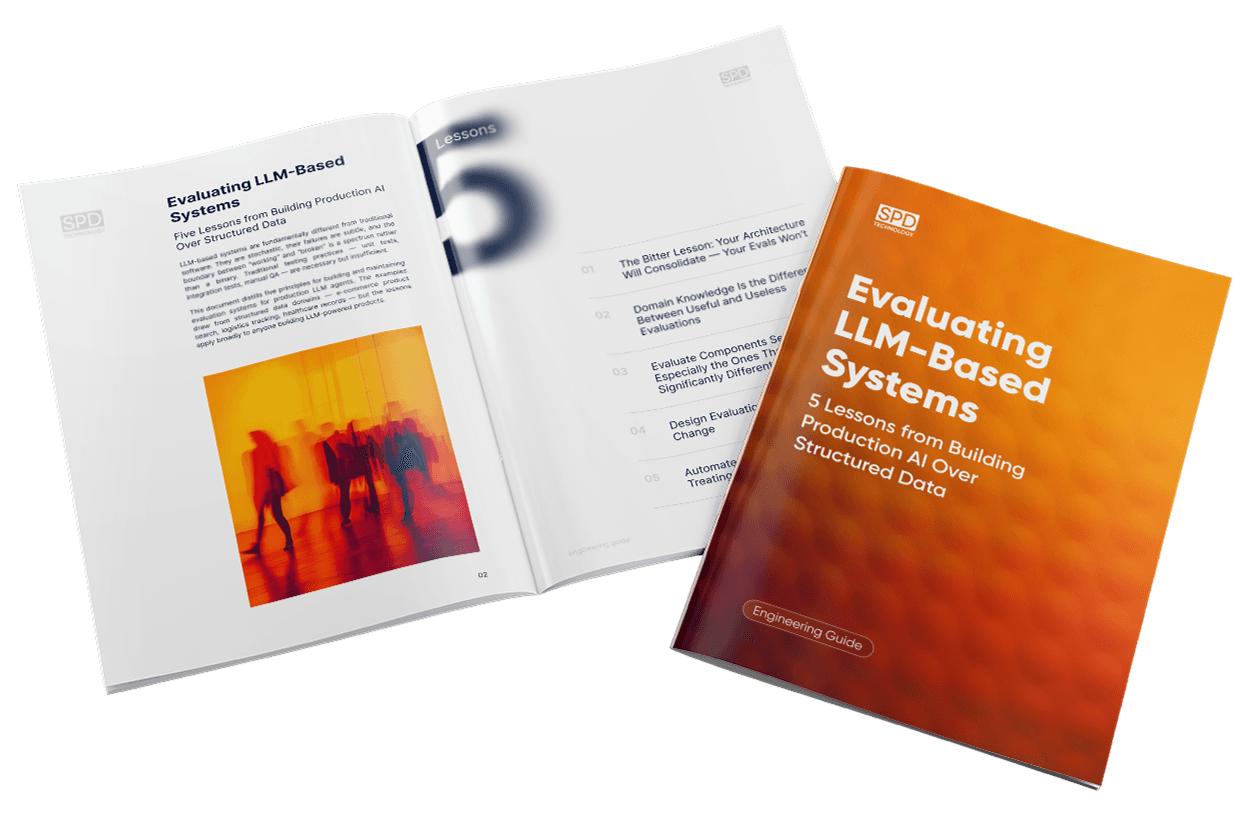
5 Practical Lessons on Evaluating Production LLM Systems

5 Practical Lessons on Evaluating Production LLM Systems

5 Practical Lessons on Evaluating Production LLM Systems

Learn how to build evals that catch subtle failures in LLM systems over structured data — from domain-aware metrics to automated pipelines.

Learn how to build evals that catch subtle failures in LLM systems over structured data — from domain-aware metrics to automated pipelines.

Based on SPD Technology’s AI/ML engineering experience

Based on SPD Technology’s AI/ML engineering experience

What’s inside the guide

What’s inside the guide

5 engineering lessons on evaluating production LLM systems over structured data.

5 engineering lessons on evaluating production LLM systems over structured data.

  • 01

    Architecture changes.

    Evals should not

    Build evaluation datasets that survive prompt, model, and system rewrites.

  • 02

    Generic metrics miss domain failures

    Use domain knowledge to catch wrong operators, taxonomy mistakes, and high-impact errors.

  • 03

    End-to-end scores hide broken components

    Evaluate extraction, tool selection, classification, safety layers, and responses separately.

  • 04

    Stable scores can create false confidence

    Design sensitive evals with production-like distributions, per-field metrics, and calibrated judges.

  • 05

    Bugs are not one-off fixes

    Turn production failures into dataset samples and automate regression checks.

Who it’s for:

Who it’s for:

For AI/ML, MLOps, and product engineers working with LLM systems in production.

For AI/ML, MLOps, and product engineers working with LLM systems in production.

  • 01

    Architecture changes. Evals should not

    Build evaluation datasets that survive prompt, model, and system rewrites.

  • 02

    Generic metrics miss domain failures

    Use domain knowledge to catch wrong operators, taxonomy mistakes, and high-impact errors.

  • 03

    End-to-end scores hide broken components

    Evaluate extraction, tool selection, classification, safety layers, and responses separately.

  • 04

    Stable scores can create false confidence

    Design sensitive evals with production-like distributions, per-field metrics, and calibrated judges.

  • 05

    Bugs are not one-off fixes

    Turn production failures into dataset samples and automate regression checks.

Built from years of AI-powered product engineering

Built from years of AI-powered product engineering

Since 2007, SPD Technology has worked with PitchBook across high-trust data, product infrastructure, and AI/ML systems.

Since 2007, SPD Technology has worked with PitchBook across high-trust data, product infrastructure, and AI/ML systems.

SPD Technology

SPD Technology is a global software product development company that creates cutting-edge tech solutions that drive clients’ growth.

PitchBook

PitchBook is a platform for private market intelligence that combines proprietary data, research, and AI systems to support real investment decisions.

  • 20+

    years in the industry

  • 650+

    experts on board

  • 72%

    Senior+ engineers

  • 20+

    years in the industry

  • 650+

    experts on board

  • 72%

    Senior+ engineers

PitchBook

PitchBook is a platform for private market intelligence that combines proprietary data, research, and AI systems to support real investment decisions.

  • 10M+

    companies in datasets

  • 100,000+

    users globally

  • 19

    years on the market

Where engineering empowers product growth

Where engineering empowers product growth

Explore current AI/ML and MLOps roles at SPD Technology

card product company

Go deeper into production LLM evaluation

Go deeper into production LLM evaluation

Explore five practical lessons for catching subtle failures in LLM systems over structured data from durable eval datasets to automated pipelines